
Sometimes even I get bored ;-) That led to this frequency counter based on Herbert DL5NEG’s circuit. I still have it.
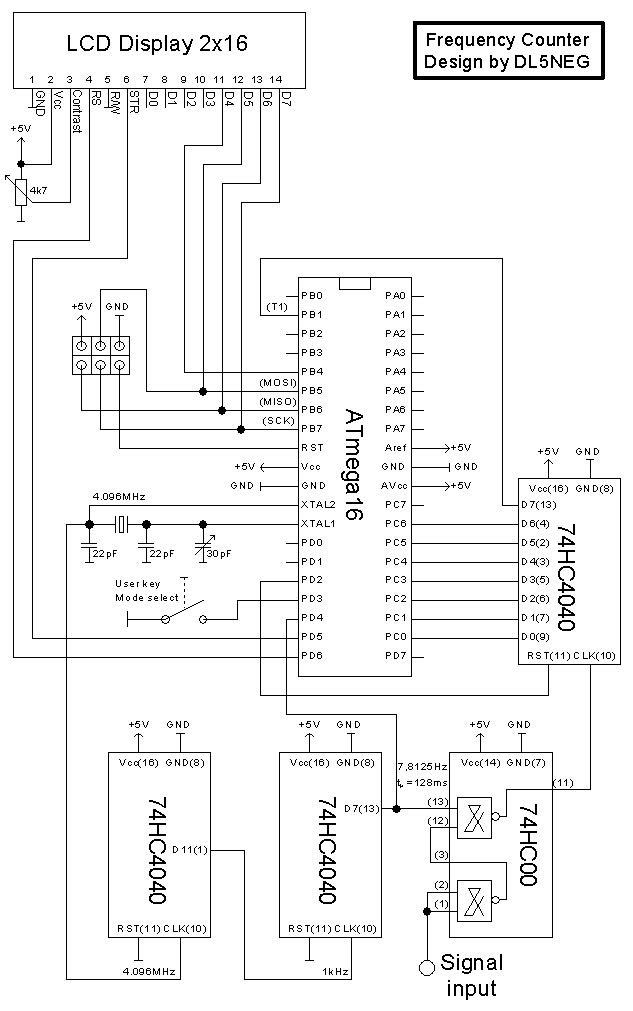
An ATmega16, a two-line LCD and a few more components form its core. Here are the principal parts and DL5NEG’s software for anyone wanting to build one.
What can it measure?
DL5NEG specifies a range up to 70 MHz with 10 Hz resolution. Frequency appears on a two-line, 16-character-per-line LCD.
Software also supports external prescalers with ratios of 64, 128, 640 and 1000. Select the mode with the pushbutton; the display accounts for the ratio. The resulting range depends on the prescaler used.
Main components
- 1 × ATmega16
- 1 × 2 × 16-character LCD
- 3 × 74HC4040
- 1 × 74HC00
- 1 × 4.096 MHz crystal
- 2 × 22 pF capacitors
- 1 × 30 pF variable capacitor
- 1 × 4.7 kΩ trimmer
- 1 × pushbutton
See DL5NEG’s schematic for wiring.

Schematic
Program the ATmega
After assembly, program the ATmega16 using the supplied HEX file. C source is also available if you want to examine how it works.
Flashing alone is not enough. Fuse bits must select the external 4.096 MHz crystal. DL5NEG describes the settings on his project page. Check how your programming software represents programmed and unprogrammed fuse bits.
Firmware and source
DL5NEG’s version 1.1 is hosted here unchanged. The ZIP contains freq_cnt.hex.
Circuit and software are by Herbert Dingfelder, DL5NEG. Thanks again for the project!